Nov. 26, 2026
Eating disorders are often associated with women, but men experience them too. For many, the pressure to maintain a particular physique can create an unhealthy relationship with food, exercise, and body image. And for gay men, expectations surrounding masculinity, attractiveness, and desirability can add another layer of pressure.
The term manorexia has been used to describe anorexia in men and boys, but it isn't a separate medical diagnosis. Its popularity points to a larger issue: eating disorders in men have historically been overlooked, misunderstood, and sometimes dismissed. Understanding how that happened, and how cultural expectations of the male body have changed, helps explain why these struggles deserve greater attention.
What Is Manorexia?
Anorexia nervosa is a serious eating disorder involving an intense fear of gaining weight, restrictive eating behaviors, and a distorted perception of body weight or shape. According to the Mayo Clinic, it can lead to severe malnutrition and potentially life-threatening complications.
Manorexia, a combination of “man” and “anorexia,” gained wider attention in 2008, including through a CBS News report. But the label itself drew criticism. In The Guardian, Charlie Porter argued that turning a serious condition into a catchy gender-specific term risked making it sound like a passing trend.
Why Male Eating Disorders Were Overlooked
When British physician William Gull introduced the clinical term anorexia nervosa in the nineteenth century, his descriptions focused largely on young women. That early framing helped establish an association between anorexia and femininity, shaping how doctors, researchers, and the public understood the condition.
As explained in the Journal of Eating Disorders' history of male anorexia nervosa, men weren’t simply overlooked in early medical thinking. When doctors did acknowledge male patients, they sometimes interpreted their symptoms through assumptions about masculinity and sexuality. In 1931, for example, British physicians attributed male cases to family dynamics and homosexuality, reflecting the prejudice of the era rather than an accurate understanding of eating disorders.
By the 1960s, researchers were identifying many of the same core features in men and women. But decades of female-focused research had already shaped diagnostic and treatment approaches, leaving male experiences less understood.
The consequences reach beyond the doctor's office. If eating disorders are portrayed as something that primarily affects women, men may struggle to recognize their own symptoms or feel that their experiences are legitimate. And while the language around eating disorders has evolved, the cultural expectations placed on men's bodies have continued to change.
The Pressure to Build the Perfect Male Body
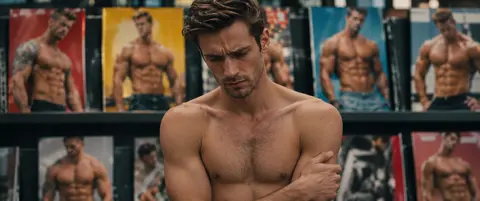
The ideal male physique has increasingly emphasized a combination of muscularity and leanness: broad shoulders, defined muscles, visible abs, and very little body fat. It's not enough to be thin; the expectation is often to be both lean and visibly strong.
That shift isn't just anecdotal. Researchers examining Playgirl centerfolds between 1973 and 1997 documented an increase in the muscularity of male models. Their study, “Cultural Expectations of Muscularity in Men: The Evolution of Playgirl Centerfolds”, offers a glimpse into how the ideal male body has evolved in popular media.
Today, social media makes those images almost impossible to avoid. A 2020 study in Body Image found that men who viewed muscular, bare-chested Instagram influencers reported lower body satisfaction than those who viewed clothed fashion or scenery images. Meanwhile, a 2025 study examining muscularity-focused social media content also found associations between exposure to this content and muscle dysmorphia among boys and men.
The result is an ideal that can be difficult to achieve and even harder to maintain. Men may feel pressure to lose body fat while simultaneously building muscle, leading to restrictive diets, rigid workout routines, and constant monitoring of their appearance. These behaviors can even receive praise as signs of discipline or dedication, making it harder to recognize when fitness habits have become unhealthy.
When Body Image Becomes Part of Belonging
Gay men experience many of the same cultural expectations surrounding male appearance, but physical attractiveness can carry additional social significance in some LGBTQ+ spaces. Dating, sex, nightlife, and social media can place appearance front and center, making it easy to feel that a particular body type is the price of admission.
Labels such as twink, jock, otter, and bear can create a sense of identity and community. But they can also reinforce expectations about what bodies are desirable. Whether the ideal is thin, muscular, or somewhere in between, the message can become that certain appearances receive more attention and acceptance than others.
A 2023 review in Body Image examined negative body image among queer men, pointing to factors such as minority stress, stigma, internalized appearance ideals, and pressure surrounding masculinity. These influences can overlap with the broader cultural expectation that men should be muscular and lean.
That pressure can also come from within the gay community. Research on gay-community stress and body dissatisfaction has examined how social comparison, competition, and appearance-based expectations can affect sexual-minority men. A related 2025 study of 314 sexual-minority men found that greater stress within the gay community was associated with higher levels of disordered eating, including food restriction, excessive exercise, and muscle-building behaviors.
When Fitness Becomes an Unhealthy Obsession
Not all eating disorders in men center on becoming thinner. Some men become consumed by the pursuit of a more muscular physique, a pattern that can involve muscle dysmorphia, sometimes informally called bigorexia. It involves a persistent belief that one's body isn't muscular enough, even when others may see someone as very fit or muscular.
This can lead to rigid meal plans, cycles of bulking and cutting, compulsive exercise, and intense anxiety about losing muscle or gaining body fat. These behaviors can overlap with disordered eating.
The distinction matters: tracking macros, following a workout plan, or wanting to build muscle isn't inherently unhealthy. The warning signs emerge when those habits become compulsive, cause significant distress, or interfere with everyday life. Someone can appear athletic or muscular while struggling with serious disordered eating behind the scenes.
Recognizing the Signs and Finding Support
One of the biggest barriers to recognizing eating disorders in men is the assumption that these conditions primarily affect women. A 2024 study in the Journal of Eating Disorders examined how stigma surrounding the perception of eating disorders as traditionally feminine can influence men's willingness to seek help. When a condition is seen as incompatible with masculinity, admitting to struggling with it can feel like another source of judgment.
Gay men may face additional pressure when body-image concerns intersect with expectations around masculinity, desirability, and acceptance. Recognizing that disordered eating can affect anyone is an important first step, and professional support can help address both the behaviors and the underlying pressures contributing to them.
You Don't Have to Earn Your Worth Through Your Body
For many gay men, the pressure to achieve a certain appearance is part of a larger pattern of trying to prove our worth. Whether it's building a successful career, finding the perfect relationship, or achieving an ideal physique, we can spend years chasing external validation to compensate for the shame or rejection we experienced growing up gay. But being desired isn't the same as being loved.
You can starve yourself, work out constantly, and obsess over every macro, but achieving a particular body won't necessarily bring the fulfillment you're looking for.
Instead of pouring all that energy into an often unattainable standard of perfection, it's worth stepping back and considering what would actually make life more fulfilling. That might mean finding healthier ways to care for yourself and investing in relationships where acceptance isn't conditional. If we only feel welcome somewhere because of how we look, that's not genuine community. Our bodies may sometimes feel like social currency in the gay world, but you don't need abs to be loved.
And remember: every day is all we have, so you've got to make your own happiness.
For more information on this topic, listen to Episode 189. Manorexia and Disordered Eating in Gay Culture.
Tune into your favorite podcast player every Tuesday for new episodes of A Jaded Gay.